A reflection on war, the environment and the human condition
We seemingly live in world existing on two battlefronts. One is immediate, visible and visceral. It’s the esclation of continuing global conflicts that threatens destruction and has devastating impacts. War. The other is more subtle, it looms over us like a background noise, heavily overshadowed the drums of warfare. Its a climate crisis that poses an future existential threat.
It is a strange feature of the human condition, that we find it easier to mobilise for destruction than for preservation. It’s as if we are biologically wired to react to the predator in the room, yet we struggle to notice when the room itself is slowly filling with smoke.
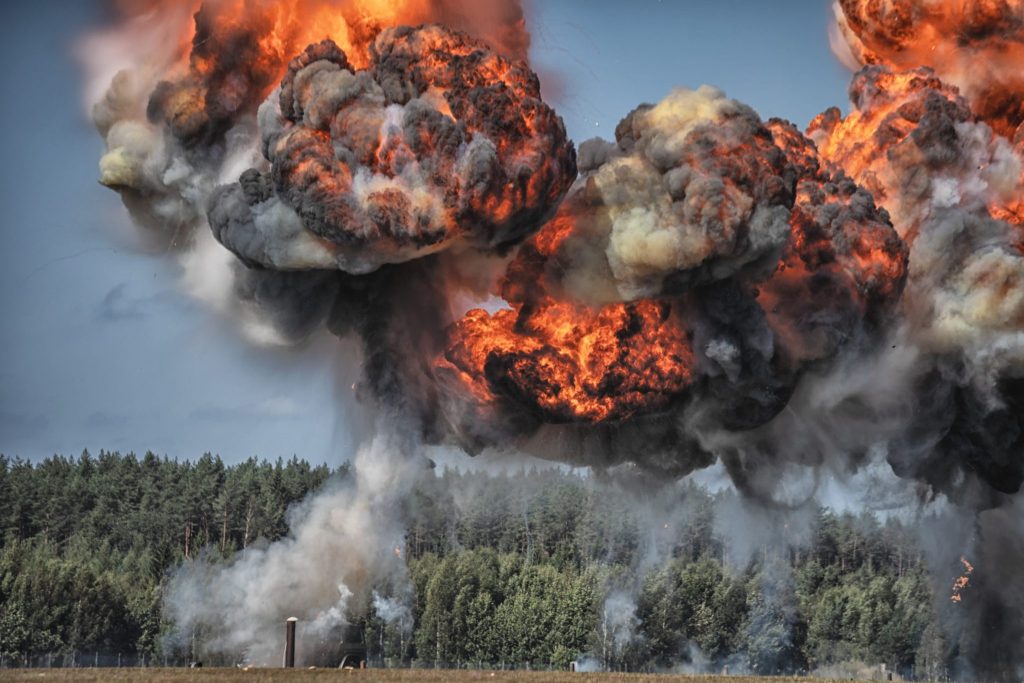
When we think about war, it is hard to look past the undeniable cost that impacts us on a human level. The kind that creates devastation for peoples, cultures and communities. It also has a simultaneously damaging impact on our environment. From the contamination of land with toxic chemicals to the pollution of vital waterways, the damage is immense. Military machinery is one of the world’s largest consumers of fossil fuels, releasing vast amounts of greenhouse gases at a time when we are meant to be drastically reducing them.
But in many ways, environmental issues don’t matter when faced with the immediate confrontational threat of warfare. Who is thinking about CO2 emissions when an enemy is charging toward you dropping bombs? It would be imprudent to suggest that environmental issues should take precident over the impacts of destruction during war..but that is not what I am saying.
I see a tragedy in the desire for real human progress that tends to focus on warfare in response to imminent threats. When environmental goals begin to gain traction, they disappear from the priority list the moment a bullet is fired. We stop looking at the health of our ecosystems because we are too busy looking at our borders. In the rush for immediate survival, we sacrifice the very environment we need to survive in the long term.
As a species, we struggle with things that “creep.” The climate crisis is a silent threat that looms over us with no immediate notice. Perhaps this is why the climate issue is so often dismissed. The effects are more subtle. They creep into our planets dysfunction. They don’t have immediate effects like an impact of war, and yet the effects are far reaching. Drought doesn’t happen in a day, but after a season a village may suffer.
Because the effects are subtle and the timeline is long, our global consciousness remains untriggered. We are hyper reactive to imminent threats but dangerously lethargic toward systemic ones.
Humans are great at adaption, and bad at prevention. This has been the case all throughout history. An issue arises, a conflict ensures, a people adapt. Human tribes adapted to changing landscapes, civilisations adapted to the rise of neighbouring powers. This cycle has repeated itself for millennia, empires thrive, conquer, and fall.
But the climate crisis presents a test that history hasn’t prepared us for. In the past, when an empire fell, the land remained, when a city was burned, it could be rebuilt on the same soil. We are used to recovering from human made ruins. This, however, is a biological baseline shift. You cannot negotiate with a drying well or ‘overthrow’ a rising tide. For the first time, we are facing a consequence that is effectively irreversible on a human timescale. Our ability to tackle the climate issue depends on our ability to prevent, not just adapt. Our ability to collaborate, and not conquer. A movement of working together, and not fraying apart.
But how do we bridge this gap in our own nature and unify under a common climate goal when the world feels increasingly fractured? If we are biologically wired to fear the predator more than the smoke, we have to learn to see the smoke for what it is: an imminent threat to the room we all share.
If we are to build a world for the future, we must learn to treat the “silent threat” with the same urgency as the “loud” one, and we must recognise that a world at war with itself is a world that has already lost its fight for a future.